A Comprehensive Look at Ethiopia’s PHC System
Ethiopia’s Primary Health Care Assessment: strengths, gaps, and the road to Universal Health Coverage
This assessment used the latest WHO framework to examine the capacity, performance, and impact of Ethiopia’s Primary Health Care system. Historic investments have yielded impressive gains in population health — but critical gaps remain in quality, readiness, and equitable service delivery.
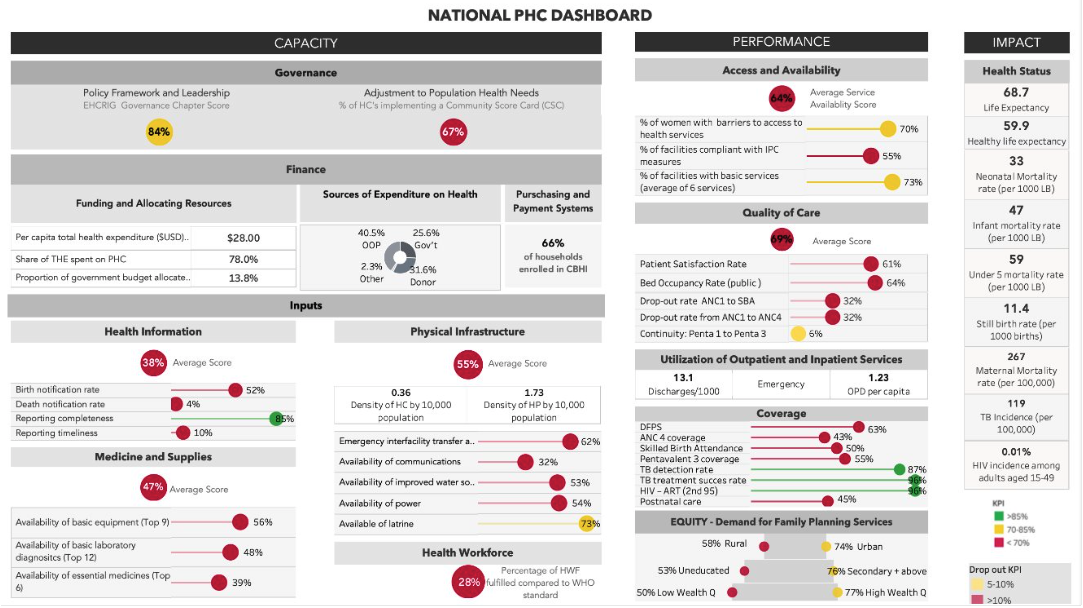
Governance, financing, and inputs
Access, quality, and equity
Outcomes for population health
Ethiopia’s health system has a foundational commitment to Primary Health Care — a strategy that has historically delivered profound benefits, including a significant increase in life expectancy over the past two decades.
However, a comprehensive assessment conducted in 2023 identified critical operational and systemic challenges that hinder the country’s progress toward achieving Universal Health Coverage. The findings below follow the assessment’s own structure: what the system has, how it performs, and what must change.
Capacity
Key challenges facing the PHC system
The PHC structure is designed as the entry point for health services. Three capacity shortages undermine its ability to provide consistent, high-quality care.
Low facility readiness and input shortages
The readiness of health facilities to meet minimum standards for quality care is very low. Nationally, only a fraction of facilities offer all of the basic client services assessed.
Supply of essential medicines, medical supplies, and diagnostics is inadequate and frequently interrupted, and many facilities lack basic infrastructure such as regular electricity and improved water sources.
Workforce deficit and imbalance
National health workforce density meets only about one-quarter of the minimum standard the WHO recommends for achieving UHC.
The shortage is compounded by uneven distribution of health professionals, producing significant regional disparities in who can actually reach a qualified provider.
Financial strain on patients and facilities
Out-of-pocket expenditure is the single largest source of funding for PHC — a heavy burden carried by the people seeking care.
Financial barriers are the leading cause of difficulty accessing health care for women.
PHC facilities also receive low or zero reimbursement for mandated exempted and fee-waiver services, jeopardizing their ability to sustain equitable, quality service delivery.
Performance
Performance gaps and the equity divide
Systemic weaknesses translate directly into performance gaps — particularly in the quality and equitable distribution of services.
Suboptimal quality of care
The overall quality of care score measured was relatively low.
Provider adherence to clinical guidelines during diagnosis and treatment is suboptimal, and provider knowledge on diagnostic accuracy needs improvement.
Equity gaps
Coverage of key services has improved over the years, but progress is not uniform. Use of Reproductive, Maternal, Neonatal, and Child Health (RMNCH) services differs starkly by:
Pathway to System Strengthening
From building more, to building stronger
To accelerate progress toward UHC, the assessment concludes that the primary focus must shift from expanding infrastructure to comprehensively strengthening foundational system elements — especially financing and institutional capacity.
Strengthen institutional capacity
Policies and strategies for PHC already exist. Institutional capacity must now be strengthened at all levels to implement and monitor them effectively.
Ensure adequate and timely financing
Government must allocate an adequate budget for PHC activities. An immediate priority: an effective mechanism for timely reimbursement of exempted and fee-waiver services.
Improve access and readiness
Facility readiness depends on closing the severe gaps in medicines, supplies, and staff training that limit what every facility can offer.
The Next Step
A dynamic PHC monitoring dashboard
The dashboard will consolidate key indicators across capacity, performance, and impact — providing real-time, actionable insights to track progress, identify bottlenecks, and guide evidence-based decision-making. By translating assessment findings into a practical monitoring tool, it will support continuous learning, accountability, and targeted investments toward Universal Health Coverage.