Ethiopia’s healthcare system has made impressive strides over the past two decades, successfully expanding essential service coverage to over 90%. However, persistent challenges in quality, facility readiness, and financing capacity needed a new, integrated approach.
To tackle these complex system bottlenecks, the Ethiopian Ministry of Health, in partnership with Amref Health Africa, launched the Integrated Health System Strengthening (IHSS) initiative. Implemented across fifteen districts (woredas) in 2024–2025, IHSS focused on fixing the foundational elements of the health system—such as governance, financing, workforce, and data—to improve service availability and quality. The initiative covered 68 health facilities and reached an estimated 1.5 million people.
--------------------------------------------------------------------------------
Immediate Impact and Significant Gains
The evaluation of IHSS used advanced methods to confirm that the integrated approach is working. Within the first year of implementation, the initiative produced measurable improvements in the quality and use of primary health services:
- Improved Service Readiness: Health facilities across the target areas showed a significant increase in their readiness to provide quality services. This indicates stronger management, better supplies, and enhanced infrastructure.
- Increased Service Utilization: There was a meaningful rise in the use of vital health services, particularly for Reproductive, Maternal, Neonatal, and Child Health (RMNCH).
- Targeted Health Benefits: By improving service delivery, IHSS is projected to lead to substantial population-level health gains, including reductions in stillbirths and major causes of under-five mortality.
--------------------------------------------------------------------------------
Exceptional Value for Investment
Beyond improving services, the IHSS initiative demonstrated remarkable efficiency, confirming that system-wide reforms are a smart investment:
- Highly Cost-Effective: The integrated intervention package was found to be highly cost-effective, delivering a massive positive "net gain" in health outcomes relative to the cost of implementation.
- Outperforming Benchmarks: The IHSS model proved to be more efficient than approximately 65% of existing Ethiopian Health Extension Program benchmark interventions. This efficiency comes from influencing multiple service areas simultaneously, rather than focusing on vertical, single-disease programs.
--------------------------------------------------------------------------------
The Engine of Change: Core System Levers
Not all interventions had the same impact. Analysis showed that improvements in readiness were driven most strongly by reforms focused on leadership, financing, and data. These high-yield interventions, which explain nearly half of the observed improvements, are essential for future scale-up:
- Strengthening Local Financing: Reforms focused on enhancing internal revenue collection and improving community-based health insurance (CBHI).
- Boosting Leadership and Governance: Building competency-based leadership and strengthening coordination across various sectors (multisectoral collaboration) to address social factors influencing health.
- Making Data Useful: Improving data quality and strengthening the use of data for planning and decision-making.
- Workforce Equity: Promoting the equitable distribution of the health workforce across facilities.
--------------------------------------------------------------------------------
A Scalable Roadmap for the Future
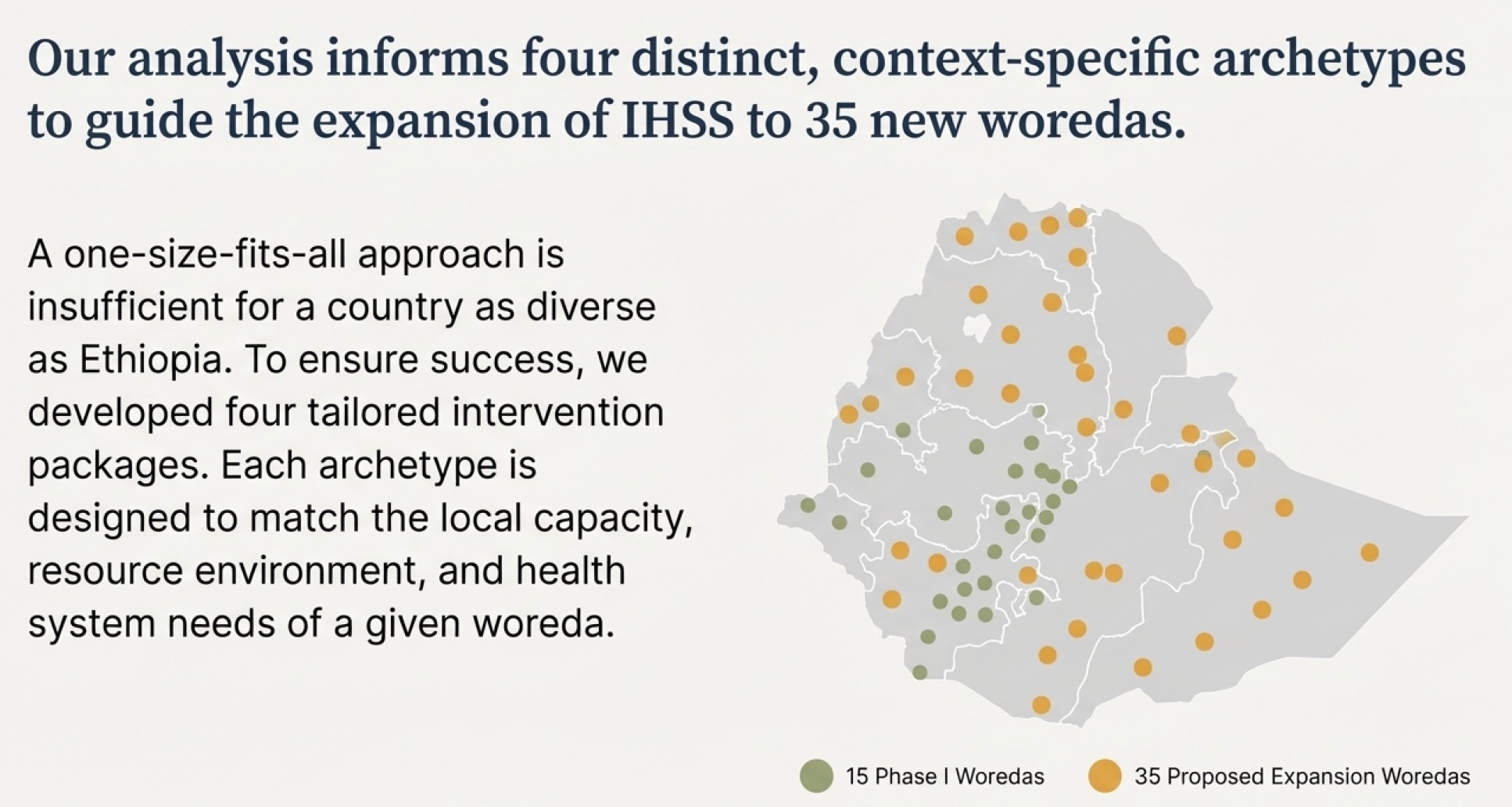
The robust evidence collected from this evaluation—which combined quasi-experimental analysis, predictive modeling, and economic analysis—has provided a clear foundation for expanding IHSS. The findings led to the development of four tailored scale-up packages, or Archetypes, designed to match intervention intensity to the specific capacity and needs of different districts.
By prioritizing these proven, high-impact system enablers, Ethiopia has an evidence-based roadmap to accelerate primary health care transformation and meet its national and global Sustainable Development Goal 3 (SDG-3) targets.